
What is MySQL? A Visual Definition
By: Wade Harvey
MySQL (pronounced “My Ess Que Ell”) is an RDBMS (relational database) that is used in many web applications today. MySQL was originally developed in 1994 by a Swedish consulting firm named TeX. The principal developer was Michael Widenius. He was seeking a database that could be fast, even at the expense of omitting many features that are included in other relational databases. The name of the company is now called MySQL AB, and their website is www.mysql.com
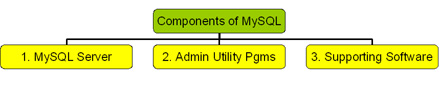
The MySQL software consists of:
- MySQL Server (MySQLd) – this is the component that does the work of executing commands against MySQL databases
- Administration Utility Programs
- Supporting Software
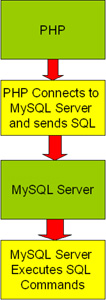
MySQL Server carries out the instructions that you write. For example, if you say CREATE DATABASE, MySQL Server is what carries out those commands. You can send instructions to MySQL Server in many ways, but PHP language is primary way used on most web sites. You talk to the relational database thru Structured Query Language (SQL). MySQL server understands SQL, but PHP does not. PHP is used to create a connection to MySQL server and to send the SQL statements to the server so that they can be executed.
Advantages of MySQL:
- It is fast
- It is inexpensive (free in most cases)
- Easy to use
- Tech support is widely available – for example, see www.mysql.com
- It can run on a wide variety of operating systems – Windows, Linux, Mac OS, most varieties of Unix(including AIX, DEC Unix, and Solaris), FreeBSD, Irix, OS/2 and more.
- It supports large databases (up to a theoretical limit of 8 million terabytes).
- It has it’s own security system for users and groups of users.
MySQL AB licenses the software in two ways:
-
Open Source Software – MySQL is available thru the GNU General Public License (GPL) for no charge. If you are using MySQL as a database for a website, it is okay even if you are making money on the web site.
-
Commercial License – If a developer wants to create a product that uses MySQL and desires to sell that product rather than release it under GPL, the developer needs a commercial license.
You can learn more about MySQL by viewing the following introductory videos:
- Meet the MySQL Database – (27 min) – This talk was given at the Hampshire Linux User Group (HantsLUG) meeting on 1st April 2006 at Southampton University.
- MySQL Basics -(1 hr.) – California Central Valley Developer and Database Professional Chad Godfirnon gives a demonstration on the basic usage of the popular open source Database application MySQL.
