DISTINCT – SQL Server Syntax Example: DISTINCT – T-SQL Example
DISTINCT – SQL Server Syntax Example: DISTINCT – T-SQL Example
Purpose: – Illustrates the SQL Server syntax for the DISTINCT.
SYNTAX:
SELECT [ ALL | DISTINCT ]
[TOP ( expression ) [PERCENT] [ WITH TIES ] ]
[ INTO new_table ]
[ FROM { table_source } [ ,…n ] ]
[ WHERE search_condition AND search_condition ]
[ GROUP BY ]
[ HAVING search_condition ]
[ ORDER BY order_expression [ ASC | DESC ]
PURPOSE:
DISTINCT allows you to ORDER BY a column in DISTINCTending order.
PURPOSE: DISTINCT allows you to only select rows that have distinct value for column(s). DISTINCT can only occur once and must precede all column names.
Code Sample for DISTINCT:
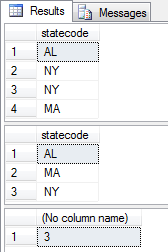
/* DISTINCT example from http://idealprogrammer.com PURPOSE: DISTINCT allows you to only select rows that have distinct value for column(s). DISTINCT can only occur once and must precede all column names. SYNTAX: SELECT [ ALL | DISTINCT ] [TOP ( expression ) [PERCENT] [ WITH TIES ] ] column1 AS displayname1, displayname2 = column_name2, column_name3 displayname3 [ INTO new_table ] [ FROM { table_source } [ ,...n ] ] [ WHERE search_condition AND search_condition ] [ GROUP BY ] [ HAVING search_condition ] [ ORDER BY order_expression [ ASC | DESC ] ] */ CREATE TABLE people( ID int, firstname varchar (20), lastname varchar (20), statecode varchar (2), alive bit, height int ) GO INSERT INTO people (ID, firstname, lastname, statecode, alive, height) VALUES (1, 'Paul', 'Revere', 'AL', 0, 72) GO INSERT INTO people (ID, firstname, lastname, statecode, alive, height) VALUES (2, 'John', 'Lennon', 'NY', 0, 69) GO INSERT INTO people (ID, firstname, lastname, statecode, alive, height) VALUES (3, 'Steve', 'Martin', 'NY', 1, 75) GO INSERT INTO people (ID, firstname, lastname, statecode, alive, height) VALUES (4, 'George', 'Washington', 'MA', 0, 65) GO --Show entire table SELECT statecode FROM people; GO -- 1. Example shows selecting distinct values SELECT DISTINCT statecode FROM people GO -- 2. Example shows using distinct with count SELECT COUNT(DISTINCT statecode) FROM people GO DROP TABLE people; GO |
Sample Output for DISTINCT Example