Split() Example Syntax VB.NET ASP.NET | Split() | Source Code
Posted by asp.net videos on Saturday, March 5, 2011 · Leave a Comment
Premium (Not Free) Video Tutorials
Free Video Tutorials & Free Tools
Premium (Not Free) Video Tutorials
Free Video Tutorials & Free Tools
Split Example Syntax VB.NET ASP.NET | Split | Source Code
Summary: – Illustrates using Split with Source Code Syntax Example in VB.NET ASP.NET.
*** 2. Split Syntax ***
Purpose:
Parses a string into a one-dimensional array of one or more
substrings. If the delimiter is not specified, space is used.
If the limit is not specified, all substrings are returned
Syntax:
Split(string[, delimiter][, limit])
| Parameters |
Description |
string |
Required – string input that you want to parse into
a one-dimensional array using a delimiter and a limit
|
| delimiter |
Optional – string delimiter that specifies
what separates the fields contained within the input string. If
no delimiter is given, space is used.
|
| limit |
Optional – integer specifying maximum number of
fields to return to the one-dimensional array. If no limit is specified,
all substrings are returned.
|
| Result Data Type |
Description |
string() |
Returns a one-dimensional string array that contains all
of the substrings that were returned from the input string.
|
*** 3. Split – Quick Example ***
|
Dim strField As String = “This”
TextBox1.Text = “[” + LTrim(strField) + Space(5) + “]” ‘Returns [This ] with leading spaces removed
|
*** 4. Split – Full Example ***
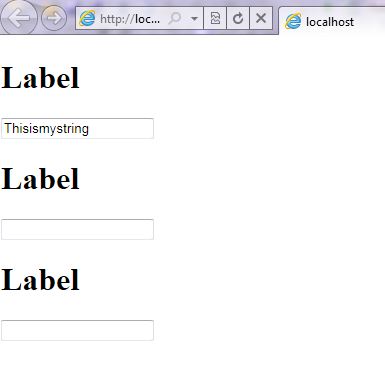
Split Example Output Screenshot
Step 1: Click on Visual Basic to Cut-n-paste code into Split.aspx.vb
Imports System
Imports System.IO
Imports System.Data

' This example is from http://idealprogrammer.com
' It shows how you can use Split syntax in VB.NET ASP.NET
'****************************************************************************************
' Purpose: Parses a string into a one-dimensional array of one or more
' substrings. If the delimiter is not specified, space is used.
' If the limit is not specified, all substrings are returned
'
' Syntax: 	 Split(string[, delimiter][, limit])
'
' Parameter1: string - Required - string input that you want to parse into
' a one-dimensional array using a delimiter and a limit
'
' Parameter2: delimiter - Optional - string delimiter that specifies
' what separates the fields contained within the input string.  If
' no delimiter is given, space is used.
'
' Parameter3: limit - Optional - integer specifying maximum number of
' fields to return to the one-dimensional array.  If no limit is specified,
' all substrings are returned.
'
' Result: string() -  Returns a one-dimensional string array that contains all
' of the substrings that were returned from the input string.
'
' Quick Example:     Dim strField As String = "This"
' TextBox1.Text = "[" + LTrim(strField) + Space(5) + "]" 'Returns [This     ] with leading spaces removed
'
'****************************************************************************************


Partial Class _Split
    Inherits System.Web.UI.Page

    Protected Sub Page_Load(ByVal sender As Object, ByVal e As System.EventArgs) Handles Me.Load

        Dim strField As String = "This is my string"
        Dim aryStrings As Array

        'split words into array
        aryStrings = Microsoft.VisualBasic.Split(strField)

        Dim sb As New StringBuilder

        'put words back together without spaces
        For i = 0 To aryStrings.Length - 1
            sb.Append(aryStrings(i))
        Next

        TextBox1.Text = sb.ToString() 'Returns Thisismystring


    End Sub
End Class |
Imports System
Imports System.IO
Imports System.Data
' This example is from http://idealprogrammer.com
' It shows how you can use Split syntax in VB.NET ASP.NET
'****************************************************************************************
' Purpose: Parses a string into a one-dimensional array of one or more
' substrings. If the delimiter is not specified, space is used.
' If the limit is not specified, all substrings are returned
'
' Syntax: Split(string[, delimiter][, limit])
'
' Parameter1: string - Required - string input that you want to parse into
' a one-dimensional array using a delimiter and a limit
'
' Parameter2: delimiter - Optional - string delimiter that specifies
' what separates the fields contained within the input string. If
' no delimiter is given, space is used.
'
' Parameter3: limit - Optional - integer specifying maximum number of
' fields to return to the one-dimensional array. If no limit is specified,
' all substrings are returned.
'
' Result: string() - Returns a one-dimensional string array that contains all
' of the substrings that were returned from the input string.
'
' Quick Example: Dim strField As String = "This"
' TextBox1.Text = "[" + LTrim(strField) + Space(5) + "]" 'Returns [This ] with leading spaces removed
'
'****************************************************************************************
Partial Class _Split
Inherits System.Web.UI.Page
Protected Sub Page_Load(ByVal sender As Object, ByVal e As System.EventArgs) Handles Me.Load
Dim strField As String = "This is my string"
Dim aryStrings As Array
'split words into array
aryStrings = Microsoft.VisualBasic.Split(strField)
Dim sb As New StringBuilder
'put words back together without spaces
For i = 0 To aryStrings.Length - 1
sb.Append(aryStrings(i))
Next
TextBox1.Text = sb.ToString() 'Returns Thisismystring
End Sub
End Class
Step 2: Click on XML to Cut-n-paste code into Split.aspx
< %@ Page Language="VB" AutoEventWireup="false" CodeFile="Split.aspx.vb" Inherits="_Split" %>

< !DOCTYPE html PUBLIC "-//W3C//DTD XHTML 1.0 Transitional//EN" "http://www.w3.org/TR/xhtml1/DTD/xhtml1-transitional.dtd">

<html xmlns="http://www.w3.org/1999/xhtml">
<head runat="server">
    <title></title>
</head>
<body>
    <form id="form1" runat="server">
    <div>
        <h1><asp:label ID="Label1" runat="server" Text="Label"></asp:label> </h1>
         <asp:textbox ID="TextBox1" runat="server"></asp:textbox><br />
          <h1><asp:label ID="Label2" runat="server" Text="Label"></asp:label> </h1>
         <asp:textbox ID="TextBox2" runat="server"></asp:textbox><br />
          <h1><asp:label ID="Label3" runat="server" Text="Label"></asp:label> </h1>
         <asp:textbox ID="TextBox3" runat="server"></asp:textbox><br />


    </div>
    </form>
</body>
</html> |
< %@ Page Language="VB" AutoEventWireup="false" CodeFile="Split.aspx.vb" Inherits="_Split" %>
< !DOCTYPE html PUBLIC "-//W3C//DTD XHTML 1.0 Transitional//EN" "http://www.w3.org/TR/xhtml1/DTD/xhtml1-transitional.dtd">
<html xmlns="http://www.w3.org/1999/xhtml">
<head runat="server">
<title></title>
</head>
<body>
<form id="form1" runat="server">
<div>
<h1><asp:label ID="Label1" runat="server" Text="Label"></asp:label> </h1>
<asp:textbox ID="TextBox1" runat="server"></asp:textbox><br />
<h1><asp:label ID="Label2" runat="server" Text="Label"></asp:label> </h1>
<asp:textbox ID="TextBox2" runat="server"></asp:textbox><br />
<h1><asp:label ID="Label3" runat="server" Text="Label"></asp:label> </h1>
<asp:textbox ID="TextBox3" runat="server"></asp:textbox><br />
</div>
</form>
</body>
</html>
Prerequistes:
- Install Visual Web Developer 2010
- Install SQL Server Express
- Download Northwind and Pubs Databases
- Attach Northwind Database to Databases in Sql Express
- Attach pubs Database to Databases in Sql Express
Notes:
- You can build your own library of syntax examples by using same web site over and over and just add new web forms to it.
Instructions:
- Use Visual Web Developer 2010
- Create new web site;
- Click File/New Web Site
- Select ASP.NET Website Template
- Select Visual Basic for Language
- name of Web Site could be VBNET_ASPNET_Syntax.
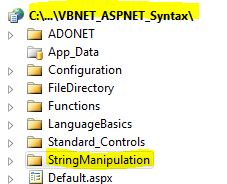
- Add New folder named “StringManipulation”
- Right-click project name in solution explorer;
- add new folder;
- name of folder could be: StringManipulation
- Add Web Form Named Split to StringManipulation folder
- Right-click StringManipulation folder;
- add new item;
- Select Web Form
- Check place code behind in separate file
- Web Form name could be Split
- Click on Visual Basic in step 1 at the top of this page to copy code into code-behind Split.aspx.vb
- Click on XML in step 2 above to copy code into web form Split.aspx
- Right-click on Split.aspx in solution explorer and select view in browser
|

 Download Source Code for All VB ASP.NET Examples in One Project – source code for hundreds of VB.NET ASP.NET examples neatly organized in a single project. Check back often to download the latest version of the project with even more code samples.