
C-Sharp Max Example – Code Sample Syntax
C-Sharp Max Example – Code Sample Syntax
Purpose: – Illustrates using C-Sharp Max Code Example.
Purpose:
Returns the Max value of the two parameters that were passed in.
Syntax:
Max(byte,byte)
Max(decimal, decimal)
Max(double, double)
Max(int16, int16)
Max(int32, int32)
Max(int64, int64)
Max(sbyte, sbyte)
Max(single, single)
Max(UInt16, UInt16)
Max(UInt32, UInt32)
Max(UInt64, UInt64)
Max(byte,byte)
Max(decimal, decimal)
Max(double, double)
Max(int16, int16)
Max(int32, int32)
Max(int64, int64)
Max(sbyte, sbyte)
Max(single, single)
Max(UInt16, UInt16)
Max(UInt32, UInt32)
Max(UInt64, UInt64)
| Parameters | Description | expression | 1. byte – returns byte that is maximum of two inputs 2. decimal – returns decimal number that is maximum of two inputs 3. double – returns double-percision floating point number that is maximum of two inputs 4. int16 – returns 16-bit integer that is maximum of two inputs 5. int32 – returns 32-bit integer that is maximum of two inputs 6. int64 – returns 64-bit integer that is maximum of two inputs 7. sbyte – returns 8-bit signed integer that is maximum of two inputs 8. single – returns single-percision floating point number that is maximum of two inputs 9. UInt16 – returns unsigned 16-bit integer that is maximum of two inputs 10. UInt32 – returns unsigned 32-bit integer that is maximum of two inputs 11. UInt64 – returns unsigned 64-bit integer that is maximum of two inputs |
|---|
| Result Data Type | Description | Depends on input | 1. byte – when input is byte 2. decimal – when input is decimal 3. double – returns double-percision floating point number 4. int16 – returns 16-bit integer 5. int32 – returns 32-bit integer 6. int64 – returns 64-bit integer 7. sbyte – returns 8-bit signed integer 8. single – returns single-percision floating point number 9. UInt16 – returns unsigned 16-bit integer 10. UInt32 – returns unsigned 32-bit integer 11. UInt64 – returns unsigned 64-bit integer |
|---|
| Quick Example | Max(1.33, 1.34)) // Returns 1.34 as decimal |
|---|
Step 1: Click cs to Cut-n-paste code into clsMax.cs
using System;
public class clsMax
{

    public void Main()
    {


        //********************************************************************************
        // Purpose: Returns the Max value of the two parameters that were passed in.
        //
        //
        // Syntax: 	Max(byte,byte)
        // Max(decimal, decimal)
        // Max(double, double)
        // Max(int16, int16)
        // Max(int32, int32)
        // Max(int64, int64)
        // Max(sbyte, sbyte)
        // Max(single, single)
        // Max(UInt16, UInt16)
        // Max(UInt32, UInt32)
        // Max(UInt64, UInt64)
        //
        // Parameter1: expression - 1. byte - returns byte that is maximum of two inputs
        // 2. decimal - returns decimal number that is maximum of two inputs
        // 3. double - returns double-percision floating point number that is maximum of two inputs
        // 4. int16 - returns 16-bit integer that is maximum of two inputs
        // 5. int32 - returns 32-bit integer that is maximum of two inputs
        // 6. int64 - returns 64-bit integer that is maximum of two inputs
        // 7. sbyte - returns 8-bit signed integer that is maximum of two inputs
        // 8. single - returns single-percision floating point number that is maximum of two inputs
        // 9. UInt16 - returns unsigned 16-bit integer that is maximum of two inputs
        // 10. UInt32 - returns unsigned 32-bit integer that is maximum of two inputs
        // 11. UInt64 - returns unsigned 64-bit integer that is maximum of two inputs
        //
        // Result: Depends on input - 1. byte - when input is byte
        // 2. decimal - when input is decimal
        // 3. double - returns double-percision floating point number
        // 4. int16 - returns 16-bit integer
        // 5. int32 - returns 32-bit integer
        // 6. int64 - returns 64-bit integer
        // 7. sbyte - returns 8-bit signed integer
        // 8. single - returns single-percision floating point number
        // 9. UInt16 - returns unsigned 16-bit integer
        // 10. UInt32 - returns unsigned 32-bit integer
        // 11. UInt64 - returns unsigned 64-bit integer
        //
        // Quick Example: Max(1.33, 1.34)) // Returns 1.34 as decimal
        //
        //********************************************************************************
        // This example is from http://idealprogrammer.com

        Console.WriteLine("Example #1: 	Max(decimal,decimal)");
        decimal decNumber1 = 1.33M;
        decimal decNumber2 = 1.34M;

        Console.WriteLine(Math.Max(decNumber1, decNumber2)); // Returns 1.34 as decimal

        //write blank line to make output easier to read
        Console.WriteLine();


        Console.WriteLine("Example #2: 	Max(douNumber1,douNumber2)");
        double douNumber1 = -3.4;
        double douNumber2 = -2.4;

        Console.WriteLine(Math.Max(douNumber1, douNumber2)); // Returns -2.4 as double
        //write blank line to make output easier to read
        Console.WriteLine();

        Console.WriteLine("Example #3: 	Max(byte,byte)");

        int byteNumber1 = 5;
        int byteNumber2 = 6;


        Console.WriteLine(Math.Max(byteNumber1, byteNumber2)); // Returns 6 as byte

        //Prevent console from closing before you press enter
        Console.ReadLine();

    }

} |
Step 2: Click cs to Cut-n-paste code into Module1.cs
Module Module1

    Sub Main()


        Dim myclsMax As New clsMax
        myclsMax.Main()


    End Sub

End Module |
Prerequistes:
- Install C-Sharp (Express or Standard Edition)
- Install SQL Server Express
- Download Northwind and pubs Database
- Attach Northwind Database to Databases in Sql Express
- Attach pubs Database to Databases in Sql Express
Notes:
- Console Application is used to simplify things, but Windows Forms or Web Forms could also be used
- You can build a library of syntax examples by using same project over and over and just commenting out what you do not want to execute in Module1.cs
Instructions:
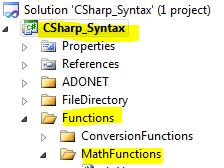
- Use C-Sharp 2010 Express or Standard Edition
- Create new project;
- Click File/New Project
- Select Console Application Template
- Select C-Sharp for Language
- name of project could be C-Sharp_Syntax.
- Add New folder named “Functions”
- Right-click project name in solution explorer;
- add new folder;
- name of folder could be: Functions
- Add New subfolder named “MathFunctions”
- Right-click Functions folder in solution explorer;
- add new folder;
- name of folder could be: MathFunctions
- Add Class Named clsMax to MathFunctions folder
- Right-click MathFunctions folder;
- add new item;
- Select class
- Class name could be clsMax
- Click on cs in code in step 1 above to copy code into clsMax.cs
- Click on cs in code in step 2 above to copy code into Module1.cs
- Click green arrow or press F5 to run program
